
Automatic Welding System Manufacturers Autobot Systems & Automation Pune, India
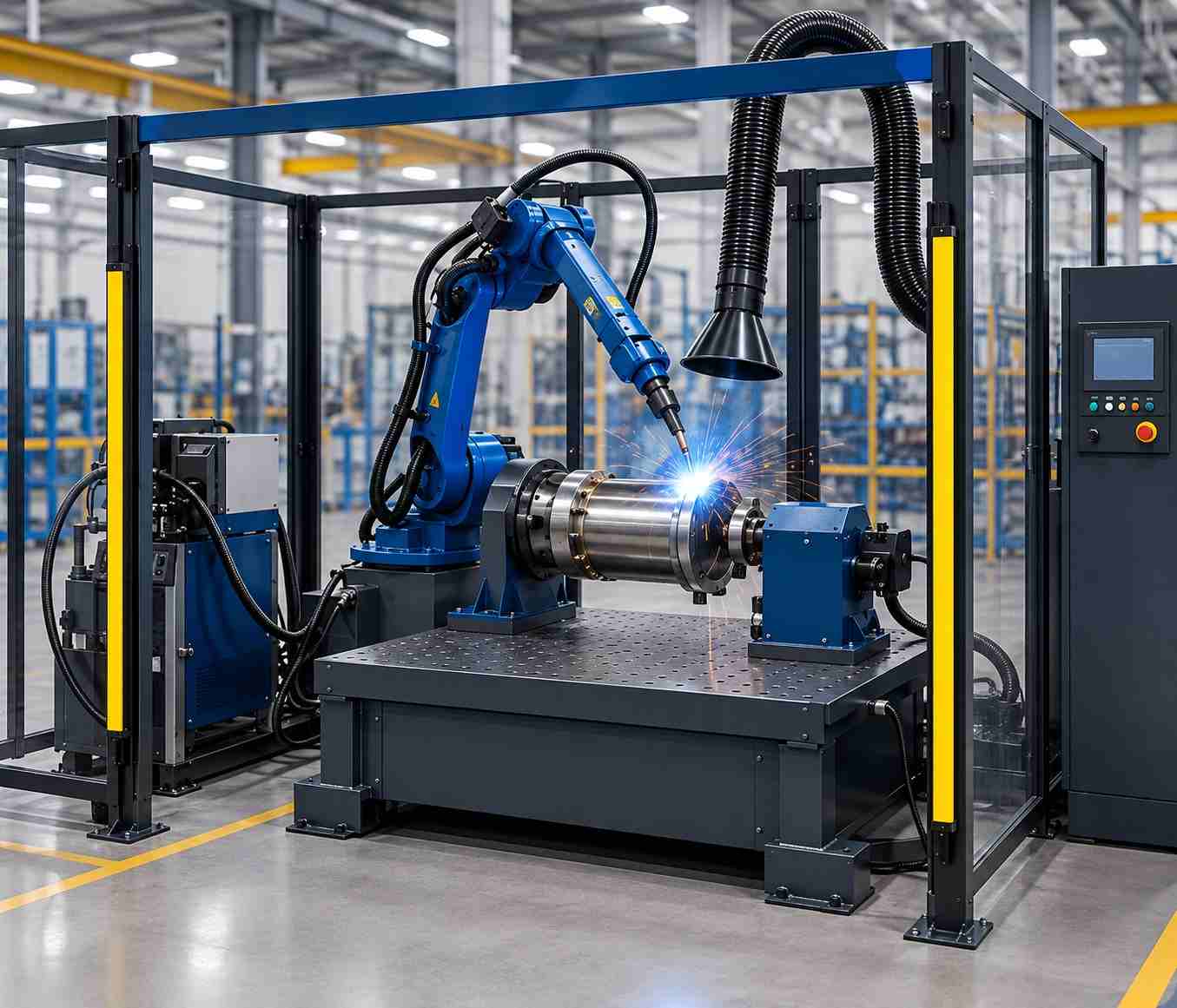
Autobot Systems & Automation is leading Automatic Welding System Manufacturers, Suppliers and Exporters in Pune India. An Automatic Welding System is an advanced industrial solution designed to automate welding operations with greater precision, consistency, and efficiency. It combines welding equipment, fixtures, controls, sensors, and automated movements to perform predefined welding tasks.
In modern manufacturing, automated welding helps industries manage repetitive production processes while maintaining consistent weld positioning and controlled operating cycles. These systems can be designed according to component geometry, welding requirements, production volume, and desired automation level.
Automatic welding systems are widely suitable for industries that require repeatable welding quality and streamlined production. By reducing repetitive manual intervention, they can help improve workflow, production consistency, and overall process control.
Discuss Your ApplicationWhat Is an Automatic Welding System?
An Automatic Welding System is a specialized welding automation setup that performs predefined welding operations with limited manual intervention. It may integrate welding equipment, robotic or mechanical movement, dedicated fixtures, sensors, controllers, and safety mechanisms. The system positions the workpiece accurately and follows a programmed welding sequence according to application requirements. Automatic welding is commonly used for repetitive manufacturing and fabrication operations. Its configuration depends on the component, material, welding process, production volume, and required cycle time.
Types of Automatic Welding Systems
As we are leading Automatic Welding System Manufacturers in India, our Types are designed to meet different application requirements and industry standards, including the following types:
Robotic Welding System
Robotic welding systems use programmable industrial robots to perform defined welding paths. They are suitable for repetitive and complex welding applications requiring controlled movement and repeatability.
Automatic Arc Welding System
These systems automate arc welding operations using controlled welding equipment and component positioning mechanisms. They are suitable for repetitive industrial welding applications.
Automatic MIG Welding System
Automatic MIG welding systems integrate MIG welding equipment with fixtures and automated movements. They are commonly suitable for fabricated components and repetitive production operations.
Automatic TIG Welding System
Automatic TIG welding systems provide controlled welding for applications requiring precision and consistent weld quality. They can be configured according to component geometry and welding requirements.
Special Purpose Welding System
Special Purpose Welding Systems are designed for specific components or production processes. They can combine dedicated fixtures, welding equipment, controls, and handling systems in one customized setup.
Working Principle of an Automatic Welding System
Component Loading
the work piece is loaded into the dedicated fixture manually or through an automated handling mechanism.
Positioning & Clamping
Locators and clamping mechanisms position and secure the component accurately before welding begins.
System Verification
Sensors and control systems check the component position, fixture condition, and required safety conditions.
Cycle Initiation
once the required conditions are confirmed, the controller starts the programmed welding sequence.
Automated Welding
The welding equipment or robotic mechanism follows the defined welding path and performs the required operation.
Process Monitoring
Depending on the configuration, sensors and control systems can monitor selected operating conditions during the welding cycle.
Cycle Completion
after the welding sequence is completed, the welding equipment stops and the machine returns to its required position.
Component Unloading
the completed component is released from the fixture and removed manually or through an automated handling system.
Technical Specifications
| Specification | Details |
|---|---|
| Machine Type | Automatic Welding System |
| Welding Process | Arc, MIG, TIG, robotic or as per application |
| Application | Component-specific welding |
| Machine Construction | Customized industrial construction |
| Fixture System | Dedicated component fixture |
| Control System | PLC, robot controller or application-specific control |
| Component Handling | Manual or automatic |
| Welding Arrangement | Fixed, robotic or automated movement |
| Automation Level | Semi-automatic or fully automatic |
| Safety System | Guards, sensors, interlocks and emergency controls |
| Production Cycle | As per component and process requirements |
| Customization | Available according to application requirements |
Features and Benefits
As Automatic Welding System Suppliers in India, our products provide several Features and Benefits including consistent quality, smooth finish, and long service life.
| Features | Benefits | Production Impact |
|---|---|---|
| Automated Welding Cycle | Provides controlled welding operations | Supports consistent production |
| Robotic Integration | Enables programmed welding movement | Improves repeatability |
| Dedicated Fixtures | Maintains accurate component positioning | Reduces positioning variations |
| PLC Control | Coordinates machine functions | Supports controlled sequencing |
| Sensor Integration | Supports process monitoring | Helps maintain process control |
| Reduced Manual Handling | Minimizes repetitive operator work | Streamlines production workflow |
| Customized Configuration | Matches specific application requirements | Supports optimized operations |
| Safety Integration | Provides suitable guards and interlocks | Supports safer machine operation |
Applications of Automatic Welding System
As Automatic Welding System Exporters in India, our all types are used in various types of industrial sectors such as:
1. Automotive Components
Automatic welding systems are used for repetitive welding of automotive components, brackets, frames, and fabricated assemblies. They support consistent positioning and controlled production cycles.
2. Sheet Metal Fabrication
These systems are suitable for sheet-metal components requiring repeatable weld locations and controlled welding movements. Automated processes can reduce repetitive manual operations.
3. Industrial Equipment
Automatic welding can be applied to industrial equipment components, frames, supports, and assemblies. Customized fixtures help maintain accurate component positioning.
4. Agricultural Machinery
Welding automation can support manufacturing of agricultural machinery components and welded assemblies. The system can be configured according to component size and welding requirements.
5. Heavy Fabrication
Heavy welding applications can use automated systems for suitable large fabricated components. Machine configuration depends on component weight, dimensions, handling, and welding process.
6. Engineering Components
Automated welding is useful for brackets, shafts, supports, housings, and other engineering components requiring repetitive welding operations.
7. Structural Components
Automatic welding systems can support repetitive fabrication of structural components and assemblies. Dedicated fixtures and controlled welding sequences help maintain production consistency.
Why Choose Automatic Welding Systems?
Improved Consistency
Automated welding follows predefined movements and sequences, helping maintain consistent welding operations across repetitive production cycles.
Higher Productivity
Automation can reduce repetitive manual activities and support continuous production workflows, particularly for suitable high-volume applications.
Better Positioning
Dedicated fixtures, locators, and clamping mechanisms help position components accurately during the welding cycle.
Reduced Operator Dependency
Automated systems can minimize repetitive welding tasks and allow operators to focus on supervision, inspection, loading, and other production activities.
Customized Automation
The system can be configured according to component geometry, welding process, production volume, cycle-time requirements, and required automation level.
Autobot Systems & Automation is leading Automatic Welding System Manufacturers, Suppliers and Exporters in India. An Automatic Welding System provides an effective solution for automating repetitive industrial welding operations. It combines welding equipment, fixtures, controls, sensors, and automated movement to support controlled production. These systems can be applied across automotive, engineering, sheet-metal, agricultural, heavy fabrication, and structural industries. Proper machine selection depends on component design, welding process, production volume, and automation requirements. A suitably designed automatic welding solution can support productivity, consistency, and efficient manufacturing operations.
FAQ’s
01
1. What is an Automatic Welding System?
An Automatic Welding System is an automated setup designed to perform predefined welding operations with limited manual intervention. It can integrate welding equipment, fixtures, controls, sensors, and automated movement.
02
2. What welding processes can be automated?
Depending on the application, arc, MIG, TIG, and robotic welding processes can be automated. Selection depends on material, joint design, component geometry, and production requirements.
03
3. Can an Automatic Welding System be customized?
Yes. Systems can be customized according to component dimensions, welding locations, production volume, cycle time, fixture requirements, handling needs, and automation level.
04
4. What are the main benefits of automatic welding?
Key benefits include consistent welding operations, accurate component positioning, reduced repetitive manual work, improved workflow, and controlled production cycles.
05
5. Where are Automatic Welding Systems used?
They are used in automotive manufacturing, sheet-metal fabrication, industrial equipment, agricultural machinery, engineering components, heavy fabrication, and structural component production.