
Robotic Welding Cell Manufacturers in Pune India Autobot Systems & Automation Pune, India
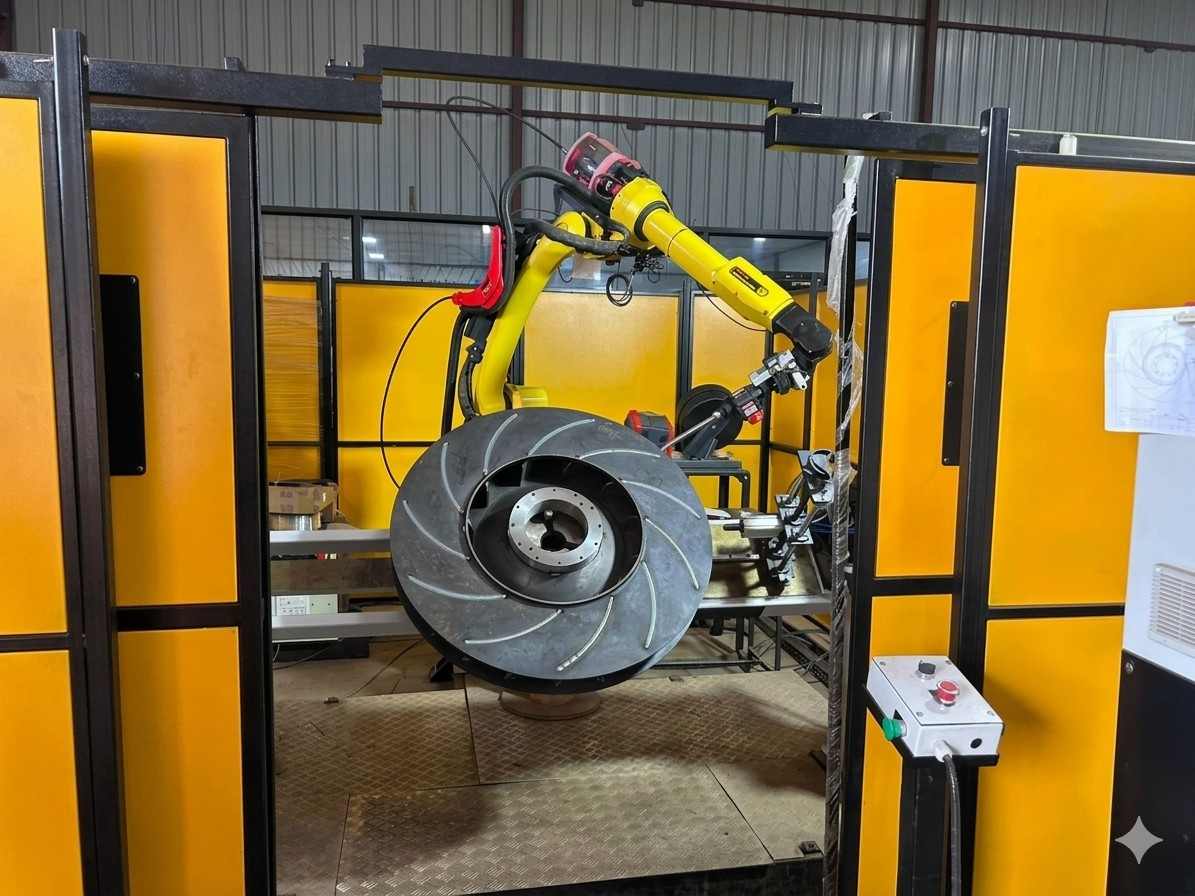
Autobot Systems & Automation is leading Robotic Welding Cell Manufacturers, Suppliers and Exporters in India. A Robotic Welding Cell is an automated manufacturing system designed to perform repetitive welding operations with controlled movement, consistent weld positioning, and improved production efficiency. It combines an industrial robot with welding equipment, fixtures, safety systems, and control components.
Robotic welding automation is increasingly used by manufacturers looking to improve production consistency while reducing repetitive manual operations. A properly designed robotic cell can coordinate component positioning, welding movements, and production sequences within a controlled work environment.
Autobot Systems & Automation provides industrial automation solutions including robotic welding, arc welding automation, Special Purpose Machines, and related automation systems. The company was established in 2013 and provides design, manufacturing, installation, and turnkey automation capabilities.
Discuss Your ApplicationWhat Is a Robotic Welding Cell?
A Robotic Welding Cell is a dedicated automated workstation in which an industrial robot performs programmed welding operations on a component or assembly. The cell generally includes a welding robot, welding power source, dedicated fixtures, control system, safety enclosure, and other application-specific equipment.
Depending on production requirements, additional systems such as positioners, handling equipment, torch-cleaning units, sensors, and inspection systems can also be integrated. Robotic welding cells are mainly used for repetitive welding applications where controlled movement, repeatability, productivity, and process consistency are important.
Types of Robotic Welding Cell
As we are leading Robotic Welding Cell Manufacturers in India, our Types are designed to meet different application requirements and industry standards, including the following types:
Single-Robot Welding Cell
A single-robot welding cell uses one industrial robot to perform defined welding operations. It is suitable for repetitive components where one robot can complete the required welding sequence efficiently.
Dual-Station Robotic Welding Cell
A dual-station cell can allow components to be loaded or unloaded at one station while welding takes place at another, depending on the system configuration. This arrangement can help optimize robot utilization and production flow.
Robotic MIG Welding Cell
Robotic MIG welding cells combine an industrial robot with MIG welding equipment for automated welding operations. They are suitable for repetitive fabrication applications requiring controlled weld paths.
Robotic Arc Welding Cell
Robotic arc welding cells are designed for automated arc welding applications. The robot follows a programmed path while the welding system performs the required operation on the component.
Multi-Robot Welding Cell
Multi-robot welding cells use more than one robot within an integrated workstation. They can be considered for complex or high-volume applications where multiple welding operations need to be coordinated.
Working Principle of Robotic Welding Cell
Component Loading
The workpiece is placed into the dedicated fixture manually or through an automated handling system, depending on the cell configuration.
Component Positioning
Locators and clamps accurately position the component so that the required welding joints are correctly aligned.
Safety and System Verification
Sensors, safety devices, and control systems verify that the cell is ready for operation before the welding cycle begins.
Robot Program Initiation
The robot controller activates the programmed welding sequence according to the defined component and process requirements.
Automated Welding
The robotic arm moves the welding torch along the programmed path while the welding equipment performs the required welding operation.
Positioning and Movement
Where required, a positioner or other integrated mechanism rotates or moves the component to provide the robot with access to different welding locations.
Cycle Completion
After completing the programmed welding sequence, the robot returns to its designated position and the welding cycle is completed.
Unloading and Inspection
The finished component is removed from the fixture and inspected according to the applicable quality requirements before continuing to the next production stage.
Technical Specifications of Robotic Welding Cell
Technical specifications are customized according to the component, welding process, production volume, and automation requirements.
| Specification | Details |
|---|---|
| Machine Type | Robotic Welding Cell |
| Robot Configuration | Industrial welding robot / As per application |
| Welding Process | MIG / MAG / Arc / As per requirement |
| Welding Power Source | Application-specific |
| Robot Controller | As per selected robotic system |
| Fixture System | Dedicated component fixture |
| Positioning System | Fixed / Rotary / Servo-based / As required |
| Component Handling | Manual / Automatic |
| Control System | PLC and robot controller integration |
| Safety System | Safety fencing, sensors, interlocks and emergency controls as applicable |
| Torch Management | Torch cleaning / maintenance systems as required |
| Automation Level | Semi-automatic / Fully automatic |
| Customization | Available according to application |
Features and Benefits of Robotic Welding Cell
As Robotic Welding Cell Suppliers in India, our products provide several Features and Benefits including consistent quality, smooth finish, and long service life.
| Feature | Benefit | Production Impact | Application Value | Key Advantage |
|---|---|---|---|---|
| Robotic Welding Automation | Performs programmed welding movements | Supports consistent production cycles | Suitable for repetitive welding | Controlled welding operation |
| Dedicated Fixtures | Holds components in the required position | Improves repeatability | Supports accurate welding | Stable component positioning |
| Programmable Welding Paths | Allows defined welding movements | Helps maintain process consistency | Suitable for complex weld paths | Repeatable operation |
| Positioning System | Provides access to different welding locations | Can improve welding accessibility | Useful for multi-sided components | Better component orientation |
| PLC & Robot Integration | Coordinates equipment and machine sequences | Supports synchronized operation | Suitable for automated production | Integrated process control |
| Torch Management | Supports torch maintenance and process reliability | Helps maintain welding performance | Useful for continuous operations | Reduced process interruptions |
| Safety Integration | Uses suitable guarding and safety devices | Supports safer operation | Suitable for industrial work cells | Controlled operating environment |
| Flexible Configuration | Can be designed around application requirements | Supports different production needs | Suitable for customized projects | Application-specific automation |
Applications of Robotic Welding Cell
As Robotic Welding Cell Exporters in India, our all types are used in various types of industrial sectors such as:
Automotive Components
Robotic Welding Cells are widely suitable for repetitive welding of automotive components and assemblies where controlled welding paths and consistent production are required.
Sheet Metal Fabrication
The cells can automate welding of fabricated sheet-metal components, helping manufacturers perform repetitive welding operations with controlled positioning.
Industrial Machinery
Robotic welding can be applied to machinery frames, brackets, supports, and fabricated assemblies requiring repeatable welding sequences.
Automotive Radiators
Specialized robotic welding solutions can be configured for suitable radiator-related components and repetitive welding processes. Autobot Systems & Automation showcases automobile radiators and related components among its application areas.
Bike Silencers
Robotic welding can support repetitive welding operations for suitable exhaust and silencer components where consistent welding paths are required.
Engineering Components
Customized robotic cells can be developed for engineering components and assemblies that require repeated welding operations and controlled component positioning.
Fabricated Structures
Robotic welding systems can support selected fabricated structures and welded assemblies where component geometry and production volume are suitable for robotic automation.
Why Choose Autobot Systems & Automation?
Industrial Automation Experience
Autobot Systems & Automation was founded in 2013 and focuses on industrial automation solutions for engineering industries. Its capabilities cover electrical engineering, automation, instrumentation, design, manufacturing, and turnkey solutions.
Robotic Welding Solutions
The company lists Robotic Welding and Arc Welding Automation Solutions among its industrial automation offerings, supporting customers looking for application-specific welding automation.
Customized Engineering
Robotic Welding Cells require careful integration of robots, fixtures, welding equipment, controls, and safety systems. Autobot Systems & Automation states that its solutions are developed to address customer requirements and industrial automation applications.
Complete Project Capabilities
The company states that it is equipped for design, manufacturing, installation, and turnkey solutions. This enables a project to be developed around the complete automation requirement rather than only an individual machine component.
Technical Support and Training
Autobot Systems & Automation also provides robot training covering operator usage, programming, and customization of robotic functions. This can help personnel understand and operate robotic systems effectively.
Autobot Systems & Automation is leading Robotic Welding Cell Manufacturers, Suppliers and Exporters in India. A Robotic Welding Cell provides a structured approach to automating repetitive industrial welding operations using robotic movement, dedicated fixtures, welding equipment, and integrated controls.
It can support improved repeatability, controlled production cycles, and reduced repetitive manual operations when appropriately designed for the application. Robotic welding cells can be customized for automotive, sheet-metal, engineering, machinery, and other suitable manufacturing applications.
Autobot Systems & Automation combines robotic welding and industrial automation capabilities with engineering, manufacturing, installation, and turnkey solution expertise. Contact Autobot Systems & Automation to discuss your robotic welding requirements and develop an application-specific automation solution.
Frequently Asked Questions
01
1. What is a Robotic Welding Cell?
A Robotic Welding Cell is an automated workstation where an industrial robot performs programmed welding operations on components or assemblies. It typically integrates welding equipment, fixtures, controls, and safety systems.
02
2. What are the benefits of robotic welding?
Robotic welding can provide consistent welding movements, repeatable production cycles, controlled process operation, and reduced repetitive manual intervention when the application is suitable for automation.
03
3. Can a Robotic Welding Cell be customized?
Yes. Robotic Welding Cells can be customized according to component geometry, welding process, production volume, fixture requirements, robot configuration, handling needs, and desired automation level.
04
4. What industries use Robotic Welding Cells?
Robotic welding can be used in automotive, sheet-metal fabrication, industrial machinery, engineering, fabrication, and other manufacturing applications involving suitable repetitive welding operations.
05
5. Why choose Autobot Systems & Automation for robotic welding?
Autobot Systems & Automation offers robotic welding and arc welding automation solutions along with design, manufacturing, installation, and turnkey automation capabilities. The company also provides robot training services for operators, technicians, and engineers.