
Robotic Welding Solution in Pune India Autobot Systems & Automation Pune, India
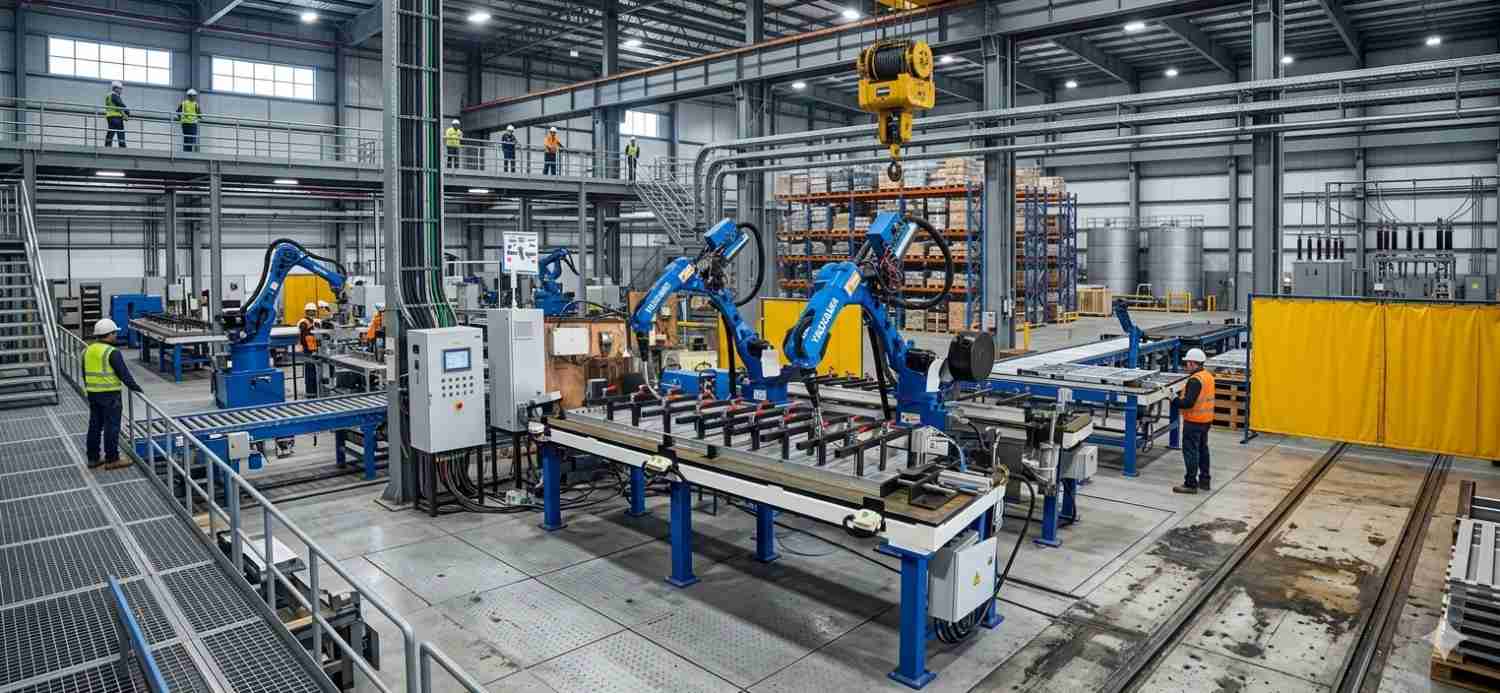
Autobot Systems & Automation is leading Robotic Welding Solutions in India. A Robotic Welding Solution is an advanced industrial automation system designed to perform welding operations with controlled movement, repeatability, and precision. It combines robotic equipment, welding tools, fixtures, controllers, sensors, and safety systems to automate repetitive welding processes.
As manufacturing industries focus on productivity and consistent weld quality, robotic welding provides an effective alternative to highly repetitive manual welding operations. Automated welding systems can follow programmed weld paths and maintain controlled movement across production cycles.
Autobot Systems & Automation provides robotic welding solutions in India, with applications covering industries where speed, accuracy, and consistent welding performance are important. Its solutions include robotic welding systems and related welding automation products.
Discuss Your ApplicationWhat Is a Robotic Welding Solution?
A Robotic Welding Solution is an automated welding system in which a programmable robotic arm performs welding operations using an integrated welding torch and control system. The robot follows predefined movements and welding paths to join components according to the required process.
Depending on the application, robotic systems can support processes such as MIG, TIG, and spot welding. Fixtures, sensors, controllers, and safety equipment can also be integrated into the welding cell. Robotic welding is particularly useful for repetitive and complex applications where consistent positioning, productivity, and controlled welding operations are required.
Types of Robotic Welding Solution
We provide Robotic Welding services in India and offer various types to meet different requirements.
Robotic MIG Welding
Robotic MIG welding systems automate MIG welding operations using a robotic arm, welding torch, wire-feeding system, and controller. They are suitable for repetitive fabrication and component welding applications.
Robotic TIG Welding
Robotic TIG welding uses programmable robotic movement to perform controlled TIG welding operations. It can be considered for applications requiring accurate torch positioning and controlled weld paths.
Robotic Spot Welding
Robotic spot welding uses robotic equipment to position and operate spot-welding tools at predefined locations. It is commonly associated with repetitive sheet-metal and assembly applications.
Robotic Sheet Metal Welding
Robotic sheet-metal welding systems are designed for automated welding of fabricated sheet-metal components. Proper fixtures and programmed paths help maintain positioning and repeatability.
Robotic Heavy Welding
Robotic heavy welding solutions are designed for large and heavy components where robust robots, suitable fixtures, and material-handling systems may be required. Applications can include heavy machinery and structural fabrication.
Working Principle of Robotic Welding Solution
Component Loading
The workpiece is placed into the dedicated welding fixture manually or through an automated material-handling system.
Component Positioning
Locators and clamps secure the component in the correct position so that the programmed welding path can be followed accurately.
Welding Program Selection
The robot controller receives the appropriate welding program containing the required movement sequence and welding parameters.
Welding Path Execution
The robotic arm moves the welding torch along the programmed path while maintaining the required torch position and movement.
Process Monitoring
Sensors and monitoring systems can be used to observe welding conditions and identify deviations during the process.
Welding Cycle Completion
After completing the programmed welds, the robot returns to its defined position and the welding cycle is completed.
Component Unloading
The finished component is removed from the fixture and transferred to the next manufacturing or inspection stage.
Technical Specifications of Robotic Welding Solution
The final configuration of a robotic welding system depends on the component, welding process, production requirements, and automation level. Typical parameters include:
| Specification | Details | Application Consideration |
|---|---|---|
| System Type | Robotic Welding System | Application-specific automation |
| Welding Process | MIG / TIG / Spot / As required | Based on material and joint design |
| Robot Payload | As per selected robot | Depends on torch, tooling and application |
| Robot Reach | As per selected robot | Based on workpiece dimensions |
| Welding Speed | As per welding process | Determined by component and weld requirements |
| Control System | Robot Controller | Controls programmed movements and sequences |
| Sensors | Process-specific sensors | Supports positioning and process monitoring |
| Fixture | Dedicated / Customized | Holds and positions the workpiece |
| Component Handling | Manual / Automated | Based on production requirements |
| Safety System | Guards, sensors, interlocks, emergency controls | Designed according to cell configuration |
| Automation Level | Semi-automatic / Automatic | As required |
| Customization | Available as per application | Designed around customer requirements |
Features and Benefits of Robotic Welding Solution
As well-known Robotic Welding Service Providers in India and below are some of the key Features and Benefits of these Services.
| Features | Benefits | Production Impact | Application Value | Key Advantage |
|---|---|---|---|---|
| Automated Precision Welding | Supports consistent weld positioning | Improves repeatability | Suitable for repetitive welding | Controlled welding performance |
| Multi-Axis Movement | Allows access to different welding positions | Supports complex weld paths | Useful for difficult-to-reach areas | Greater flexibility |
| Dedicated Fixtures | Maintains component positioning | Reduces movement during welding | Supports repeatable production | Improved alignment |
| Process Monitoring | Helps identify process deviations | Supports quality control | Useful for automated production | Better process visibility |
| Robotic Integration | Automates programmed welding operations | Can improve production efficiency | Suitable for repetitive applications | Reduced manual intervention |
| Flexible Programming | Allows predefined welding paths and sequences | Supports production adaptability | Useful for different component requirements | Programmable operation |
| Safety Integration | Separates operators from hazardous welding areas | Supports safer operation | Suitable for industrial welding cells | Improved workplace safety |
| Automation Compatibility | Can integrate with handling and related automation | Supports streamlined production | Suitable for automated manufacturing | Integrated workflow |
Applications of Robotic Welding Solution
Our high-precision Robotic Welding Services in India are suitable for multiple industrial applications as listed below:
Automotive Manufacturing
Robotic welding is used for automotive components and assemblies where repeatability, production speed, and consistent weld quality are important. Applications can include frames and exhaust-related components.
Aerospace Manufacturing
Robotic welding can support selected aerospace manufacturing operations where controlled welding movement and precision are required. The process can be adapted to suitable components and materials.
Heavy Machinery
Heavy machinery manufacturers can use robotic welding for large and complex fabricated components. Suitable robots, fixtures, and handling systems can be configured according to component requirements.
Shipbuilding
Robotic welding can be applied to suitable shipbuilding and large fabricated structures where repeatable welding operations are required. System design depends on component size and production conditions.
Sheet Metal Fabrication
Robotic welding is useful for repetitive sheet-metal welding applications where precise weld paths, fixtures, and consistent production are required.
Aluminium Components
Robotic MIG welding can be used for suitable aluminium components, with welding equipment, torch configuration, wire feeding, and programming selected for the material and application.
Industrial Fabrication
Robotic welding solutions can support industrial fabrication applications involving repetitive welded components and assemblies. The welding cell can be customized around component geometry and production requirements.
Why Choose Autobot Systems & Automation?
Specialized Automation Expertise
Autobot Systems & Automation focuses on industrial automation and offers Special Purpose Machines, Arc Welding Automation Solutions, Handling Automation Solutions, and Robotic Welding.
Customized Robotic Solutions
The company states that its robotic welding systems can be tailored to specific business requirements. This allows the welding setup to be planned around the component, process, and production objectives.
Multiple Welding Applications
Autobot provides robotic welding solutions for different industrial requirements, including sheet-metal and heavy-welding applications. This supports application-specific automation planning.
Technical Support
Robotic automation requires proper operation, programming, maintenance, and troubleshooting. Autobot also provides robot training and maintenance-related services to support robotic system operation.
India-Based Automation Provider
Autobot Systems & Automation is based in Talawade, India, Maharashtra, and provides industrial automation solutions for customers in India and other markets.
Autobot Systems & Automation is leading Robotic Welding Solutions in India. A Robotic Welding Solution provides manufacturers with a structured approach to automating repetitive and complex welding operations. By combining robotic movement, welding equipment, fixtures, controls, sensors, and safety systems, the solution can support consistent and controlled production.
It can be applied across automotive, sheet-metal, heavy machinery, aluminium, and other suitable manufacturing processes. The right robotic welding configuration depends on the component, welding process, production volume, and required automation level. Autobot Systems & Automation can help manufacturers evaluate their requirements and develop an application-specific robotic welding solution.
Frequently Asked Questions
01
1. What is a Robotic Welding Solution?
A Robotic Welding Solution is an automated system that uses a programmable robot and welding equipment to perform predefined welding operations. It is designed to improve repeatability, process control, and production efficiency.
02
2. Which welding processes can robotic welding support?
Depending on the application, robotic welding systems can support processes such as MIG, TIG, and spot welding. The appropriate process is selected based on the material, joint design, component, and production requirements.
03
3. What are the main benefits of robotic welding?
Key benefits include repeatable welding movements, controlled production cycles, reduced repetitive manual intervention, and the ability to perform programmed welding paths consistently.
04
4. Can a robotic welding system be customized?
Yes. Robotic welding cells can be configured according to component dimensions, welding process, fixture requirements, robot reach, payload, production volume, handling requirements, and safety considerations.
05
5. Why choose Autobot Systems & Automation for robotic welding?
Autobot Systems & Automation offers Robotic Welding along with Arc Welding Automation, Special Purpose Machines, and related automation solutions. The company also provides robot training and maintenance-related services to support robotic automation systems.