
Welding Automation Autobot Systems & Automation Pune, India
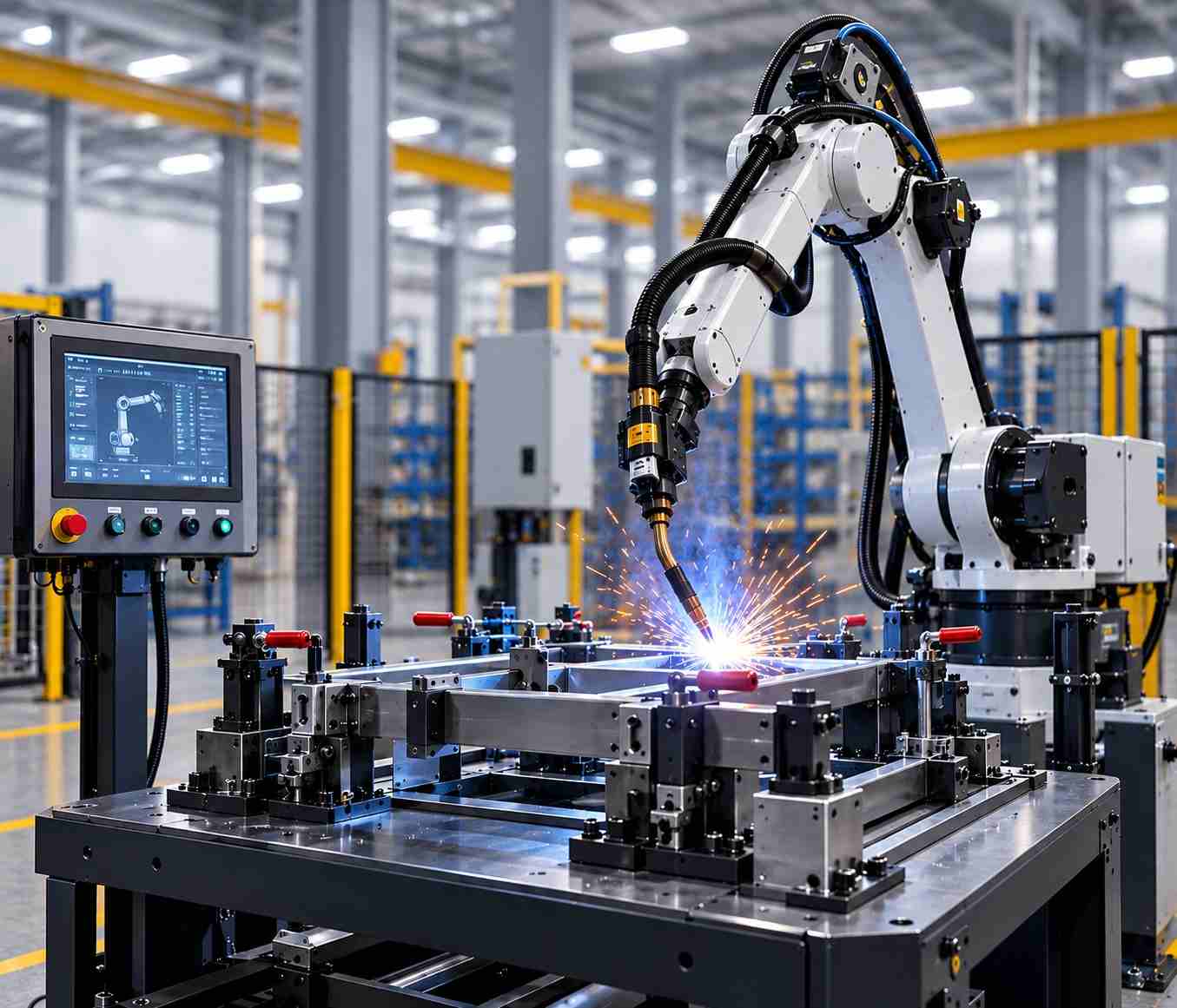
Autobot Systems & Automation is providing Welding Automation Solutions and leading Welding Automation Manufacturers, Suppliers and Exporters in India. Welding Automation is an advanced manufacturing approach that uses automated equipment, control systems, fixtures, and robotic technology to perform welding operations with improved consistency and process control. It helps manufacturers manage repetitive welding tasks more efficiently.
As production requirements increase, industries need welding solutions that can support repeatability, controlled cycle times, and reduced dependency on manual operations. Automated welding systems can be designed according to component geometry, material, welding process, and production volume.
Autobot Systems & Automation provides industrial automation solutions, including Special Purpose Machines, arc welding automation, robotic welding, and application-specific automation systems. These solutions can be developed to address different manufacturing and welding requirements.
Discuss Your ApplicationWhat Is Welding Automation?
Welding Automation refers to the use of machines, automated controls, robotic systems, fixtures, and material-handling mechanisms to perform welding operations with limited or reduced manual intervention. The main purpose is to automate repetitive or precisely controlled welding processes while maintaining consistent component positioning and process parameters. Welding automation is widely used in automotive, engineering, sheet metal, fabrication, and industrial manufacturing applications. Depending on the production requirement, the system can range from a semi-automatic welding setup to a fully automated robotic welding cell.
Types of Welding Automation
As we are leading Welding Automation Manufacturers in India, our Types are designed to meet different application requirements and industry standards, including the following types:
Robotic Welding Automation
Robotic welding automation uses industrial robots to perform programmed welding paths and repetitive operations. It is suitable for components with complex weld locations or production requirements involving repeatability.
Arc Welding Automation
Arc welding automation integrates automated movement, component positioning, and welding equipment for controlled welding operations. It can be configured according to the component and required welding sequence.
Special Purpose Welding Machines
Special Purpose Machines are designed for specific welding applications and component geometries. Dedicated fixtures and automation mechanisms allow the system to perform defined welding operations efficiently.
Automated Spot Welding
Automated spot welding systems perform repetitive resistance welding operations at predefined locations. They are commonly used for sheet metal assemblies and components requiring multiple weld points.
Automated Seam Welding
Automated seam welding systems are designed to perform welding along continuous or defined joint paths. The movement and welding sequence can be controlled according to the application.
Working Principle of Welding Automation
Component loading
The component is loaded into the welding station manually or through an automated handling system, depending on the level of automation.
Accurate Positioning
Dedicated fixtures, locators, and clamping mechanisms position and secure the component for the welding operation.
System Verification
Sensors and control systems verify component positioning, safety conditions, and machine readiness before the welding cycle begins.
Automated Welding Cycle
The welding machine, robotic system, or automated mechanism performs the programmed welding operation according to the defined sequence.
Controlled Movement
Where required, robotic arms, rotary mechanisms, linear slides, or positioners move the welding tool or component along the required welding path.
Cycle Completion
After completing the welding sequence, the system stops the operation and prepares the component for unloading or the next manufacturing stage.
Component Unloading
The finished component is removed manually or through an automated handling system for further inspection, assembly, or processing.
Technical Specifications
| Parameter | Specification | Details |
|---|---|---|
| System Type | Welding Automation System | Customized according to application |
| Welding Process | Arc, MIG, TIG, Spot, Robotic | Selected as per welding requirement |
| Component Handling | Manual, Semi-Automatic, Automatic | Based on production requirements |
| Fixture System | Dedicated, Customized | Designed for component positioning |
| Control System | PLC, Robot Controller | Application-specific automation control |
| Machine Movement | Fixed, Linear, Rotary, Robotic | Selected according to welding path |
| Automation Level | Semi-Automatic, Fully Automatic | Available as per requirement |
| Safety System | Guards, Sensors, Interlocks | Emergency controls as applicable |
| Production Cycle | Application-Specific | Based on component and process |
| Customization | Available | Designed according to project requirements |
Features and Benefits
As Welding Automation Suppliers in India, our products provide several Features and Benefits including consistent quality, smooth finish, and long service life.
| Feature | Benefit | Production Impact | Application Value | Key Advantage |
|---|---|---|---|---|
| Customized Automation | Matches the specific welding process | Supports efficient workflow | Suitable for unique components | Application-focused design |
| Dedicated Fixtures | Maintains accurate positioning | Improves repeatability | Supports repetitive production | Consistent alignment |
| Automated Welding Cycle | Controls welding sequences | Supports consistent operation | Useful for repetitive tasks | Reduced process variation |
| Robotic Integration | Automates complex movements | Supports efficient production | Suitable for programmed weld paths | Improved flexibility |
| PLC-Based Control | Coordinates machine functions | Improves process control | Supports automated sequences | Reliable operation |
| Reduced Manual Handling | Minimizes repetitive operator tasks | Supports better workflow | Useful in production environments | Lower manual dependency |
| Flexible Configuration | Adapts to different requirements | Supports varied applications | Suitable for customized projects | Scalable automation |
| Safety Integration | Includes suitable protective systems | Supports safer operation | Important for industrial environments | Improved operational safety |
Applications of Welding Automation
As Welding Automation Exporters in India, our all types are used in various types of industrial sectors such as:
1. Automotive Manufacturing
Welding automation is used for repetitive welding of automotive components, fabricated assemblies, brackets, structural parts, and other production components requiring controlled processes.
2. Sheet Metal Fabrication
Automated welding systems can perform repetitive welding on sheet metal components with dedicated fixtures and controlled welding paths.
3. Industrial Machinery
Manufacturers use welding automation for machine frames, fabricated structures, supports, brackets, and other engineering components requiring repeatable welding operations.
4. Agricultural Equipment
Welding automation can support the production of agricultural machinery components and fabricated assemblies where repetitive welding processes are required.
5. Electrical and Engineering Components
Customized automated welding systems can be developed for suitable electrical enclosures, engineering assemblies, frames, and fabricated metal components.
6. Heavy Fabrication
Automated welding solutions can be configured for larger fabricated components depending on material, dimensions, welding requirements, and handling arrangements.
7. General Manufacturing
Welding automation is suitable for industries producing repetitive welded components where improved consistency, controlled processes, and efficient production workflows are required.
Why Choose Autobot Systems & Automation?
Customized Automation Solutions
Autobot Systems & Automation develops industrial automation solutions according to specific component, process, and production requirements. This approach helps create systems suitable for individual manufacturing applications.
Welding Automation Expertise
The company offers solutions related to Special Purpose Machines, arc welding automation, and robotic welding. This provides different automation approaches based on the required application.
Engineering and System Integration
Welding automation requires the integration of mechanical systems, fixtures, welding equipment, controls, and handling mechanisms. Application-specific engineering helps these elements work together effectively.
Turnkey Project Support
Autobot Systems & Automation provides engineering, commissioning, and installation support for industrial automation projects. This helps customers move from concept and machine development toward implementation.
Application-Focused Approach
Every manufacturing process has different component designs and production requirements. The company focuses on understanding these requirements before developing a suitable automation solution.
Autobot Systems & Automation is leading Welding Automation Manufacturers, Suppliers and Exporters in India.Welding Automation provides manufacturers with a practical way to automate repetitive and controlled welding operations. By integrating suitable welding equipment, fixtures, control systems, robotics, and material handling, an automation system can be designed around specific production requirements. It can be applied across automotive manufacturing, sheet metal fabrication, industrial equipment, agricultural machinery, and other engineering applications. Autobot Systems & Automation offers application-focused solutions involving welding automation, Special Purpose Machines, and robotic systems. Contact the team to discuss your component and production requirements and identify a suitable welding automation solution.
FAQ’s
01
1. What is welding automation?
Welding automation uses machines, controls, fixtures, robots, or automated mechanisms to perform welding operations with reduced manual intervention and controlled process sequences.
02
2. What are the main types of welding automation?
Common types include robotic welding, arc welding automation, Special Purpose Welding Machines, automated spot welding, and automated seam welding systems.
03
3. Can a welding automation system be customized?
Yes. Welding automation systems can be customized according to component geometry, material, welding process, production volume, cycle time, and required automation level.
04
4. What are the benefits of welding automation?
Welding automation can improve process consistency, support repeatable production, reduce repetitive manual tasks, and provide controlled welding sequences for suitable applications.
05
5. How do I select the right welding automation system?
The right system depends on the component design, welding process, production quantity, required cycle time, available space, material handling requirements, and desired level of automation.